



We’ve created these information sheets to help with common concerns after a stroke. Browse topics in alphabetical order and click the link to read or print them.
Click the button 'Français' above for the French versions of these sheets.
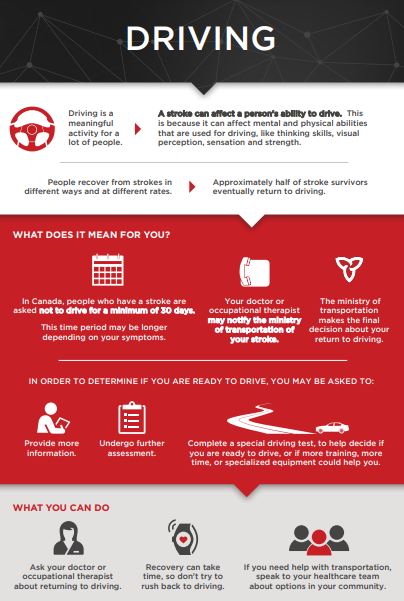
(sample)
 Advance Care Planning Preparing an advance care plan can ensure that you receive treatment that honours your values and wishes.
Aphasia is when the part of the brain that controls speech and language is injured because of a stroke.

Alcohol Recommendations Drinking less alcohol is better for your health. Read these tips to learn how to reduce your drinking, and learn what a standard alcoholic drink is.
 Balance and Falls Post Stroke About 40% of all stroke survivors will fall within the first year.
 Blood Pressure Monitoring at Home Measuring your blood pressure at home is one of the best ways to know if it is under control.
 Blood Pressure Medication Information High blood pressure is the number one risk factor for stroke.
 Changes to Emotions and Mood Approximately one-third to two-thirds of stroke survivors will experience depression. Communication Aphasia, speech problems and cognitive-communication problems.
 Delirium is a suddenly confused state of mind. Delirium is common in acute stroke. (Credit: The Ottawa Hospital and the Champlain Region Patient, Family and Caregiver Education Program)
  Driving A stroke can affect the mental and physical abilities that are needed for driving.
Problems with chewing and swallowing food and liquids.
 Exercise and Mobility Exercise is an important part of recovery and can reduce your risk of having another stroke by about 30%.
 Fatigue Post Stroke is intense tiredness that isn’t always related to how active you’ve been and does not improve as quickly with rest.
 Healthy Eating The food we eat can play an important part in preventing a stroke.
 Incontinence With lifestyle changes and treatment, about 80% of incontinence problems can be resolved.
 Medication - Taking your Medications After a stroke or a mini-stroke, your risk of having another stroke is higher.
 Medication - Apixaban (Eliquis®) Apixaban is an oral anticoagulant, often called a “blood thinner”.
Medication - Aspirin Your doctor prescribed baby aspirin to keep blood clots from forming.
Medication - Clopidogrel (Plavix®) Your doctor prescribed clopidogrel to keep blood clots from forming.
Medication - Dabigatran (Pradaxa®) Dabigatran is an oral anticoagulant, often called a “blood thinner”. Medication - Edoxaban (Lixiana®) Edoxaban is an oral anticoagulant, often called a “blood thinner”. Medication - Rivaroxaban (Xarelto®) Your doctor prescribed rivaroxaban to keep blood clots from forming. Medication - Statins Your doctor prescribed a statin to lower cholesterol and avoid stroke or heart attack. Medication - Warfarin (Coumadin®) Your doctor prescribed warfarin to keep blood clots from forming. Oral Health Poor oral health is linked to serious health problems.
 Pain About a third of all stroke survivors will experience pain.
 Quitting Smoking Smoking can increase your risk of stroke by as much as three times.
 Sexuality Post Stroke Up to 75% of stroke survivors will experience a change in their ability and/or desire to return to sexual activity.
 Spasticity is increased activity or “tone” in your muscles making them feel stiff and tight.
 Visual Field Deficit One-third of stroke survivors will have some loss of vision.